
Your Next AI Query May Be Powered by a Lithium-Ion Battery
Surging electricity demand from AI data centers is turning battery energy storage, and the software that keeps those batteries healthy, into critical grid infrastructure.
To physicists, conservation of energy means that energy in an isolated system cannot be created or destroyed. Richard Feynman, my physics hero and a professor at my alma mater, Caltech, described it as a "number which you can calculate as nature undergoes its multitude of changes, this number does not change." To environmentalists, conservation of energy means using energy as efficiently as possible and reducing wasteful consumption. To state and federal policymakers, conservation means the strategic management of energy supply and demand, infrastructure planning and economic impact. All these definitions are now converging with the exponential rise of AI compute and its insatiable demand for energy.
AI Electricity Demand and the U.S. Grid
After nearly two decades of relatively flat demand, U.S. electricity consumption is growing rapidly, driven largely by the massive buildout of AI data centers (AIDC) and EV infrastructure. Projected to increase 15-20% by 2030, the increase works out to an additional 800 TWh, equal to the entire national U.S. electrical consumption in 1965. A single hyperscale AI campus can require 500-1000 MW of power. One highway fast-charging plaza with 20 to 30 chargers can require between 5 and 15 MW of instantaneous power.
The challenge is no longer simply finding new reliable energy sources. It is also delivering large amounts of power to the right place at the right time. The U.S. grid was never designed for this type of demand profile.
I cheated a little. I equated energy with one specific form, electricity. Historically, oil and fossil fuels were a practical source of energy, available nearly on demand, readily transportable, relatively affordable, and most importantly, easy to store. It is the necessary transition to electrical energy that is driving a rethinking of how we source and distribute energy, and above all, how to store it. The addition of renewable sources and nuclear energy makes storage even more critical.
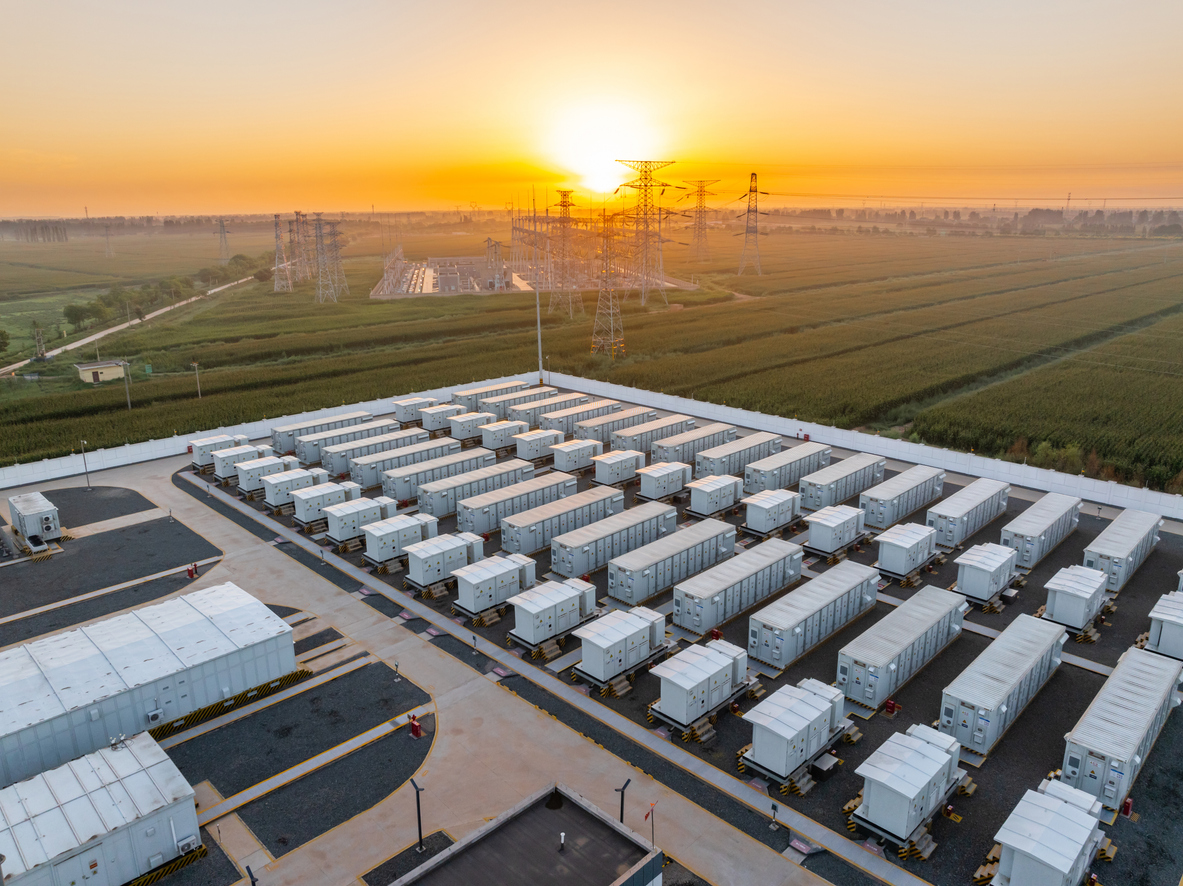
Fora hundred years, we didn't worry about storing electricity on a large scale. This is now changing, and utility-scale batteries are playing a big role in the modern grid. Morgan Stanley forecasts Battery Energy Storage Systems (BESS) U.S. deployments to exceed 300 GWh annually by 2030, enough to power approximately 82,000 homes for an entire year. According to Morgan Stanley, about 60% of future U.S. BESS deployments will support AI-related infrastructure!
Battery Energy Storage
Consider this simple example. An AI data center may experience rapid changes in compute demand as large GPU clusters ramp up or down. In many cases, the local utility connection may not be capable of instantly delivering those transient power spikes without major transmission upgrades. A co-located BESS installation can absorb these power peaks, stabilize the local grid connection, and reduce the need for infrastructure upgrades. A BESS installation can also support localized EV charging infrastructure, provide frequency regulation, and renewable energy peak shifting (storing the energy when the sun is shining and delivering the energy back in the evening). Battery storage is not replacing the grid. It is making the grid considerably more efficient.
However, repeatedly cycling large battery systems under demanding operating conditions creates another problem: long-term degradation, thermal stress, and operational risks, including battery fires. BESS sites are very large, often spanning hundreds of battery containers, with each container delivering roughly 5 MWh. Procuring a single 1 GWh site can require capital expenditures between $250M and $500M. At this scale, maintaining these assets, securing financing and insurance, and guaranteeing operational integrity, uptime, and safety represent the thin line between profitability and financial failure. Because of this, the industry is now shifting from the question of "Can we build large storage systems?" to "Can we operate them safely and economically for 15+ years at utility scale?" The January 2025 Vistra Energy fire incident in Moss Landing, California, served as a stark reminder that predictive safety must be central to all future deployment strategies.
Battery Economics
The long-term economics of BESS are ultimately dictated by asset predictability: battery degradation, replacement cycles, minimized downtime, and the cascading effects these factors have on insurance and financing costs. A merchant BESS business model typically assumes an operating life of 15 to 20 years, requiring high utilization and active participation across multiple energy markets. If a battery system loses 20"“30% of its usable capacity faster than forecasted, the revenue model collapses. For financiers, predictable performance compresses the cost of capital. Uncertainty does the opposite, driving financing spreads and insurance premiums materially higher.
This is precisely where intelligent software and advanced control systems become necessary. Operating as digital layers above the battery chemistry and choice of suppliers, these platforms leverage predictive analytics for real-time safety monitoring and early anomaly detection. They measure in real-time the health and condition of each battery cell across the system. Intelligent algorithms, some of them AI-driven, structure the large data streams, analyze them, and make instantaneous decisions regarding the battery's operation. By deploying adaptive charging protocols, optimizing degradation management, and continuously monitoring charge imbalances across individual cells and modules, intelligent software does something hardware alone cannot: it helps transform inherently aging chemical systems into more stable, predictable, and financeable infrastructure assets. This is not the future, it is the present.
As the AI-driven power crunch intensifies, the winners of the BESS boom will not simply be the companies deploying the most hardware. They will likely be the companies that can operate these assets safely, efficiently, and predictably for decades. Increasingly, that capability and reliability will depend on the software intelligence embedded within these systems.

